
Welcome to Samburusafari.com—your direct local authority on luxury and mid-range northern Kenya safaris. For travelers seeking refined comfort, unvarnished local expertise, and absolute peace of mind during their Samburu Safari, we are northern Kenya’s finest choice on the ground.
We never recommend staying more than three nights in the same reserve. The best way to see Kenya is to mix the dry northern plains with a private conservation area down closer to the highlands.
Our standard trips loop straight into the nearby Ol Pejeta Conservancy. This keeps your driving times down while letting you see the northern wildlife on day one, and East Africa’s biggest black rhino sanctuary on day three.
The prices below show the total cost per person based on two people traveling together in a private 4×4 Safari Land Cruiser, valid for the upcoming travel seasons. So there are no surprises when the invoice arrives, next you will find exactly what your money covers — and what it does not.
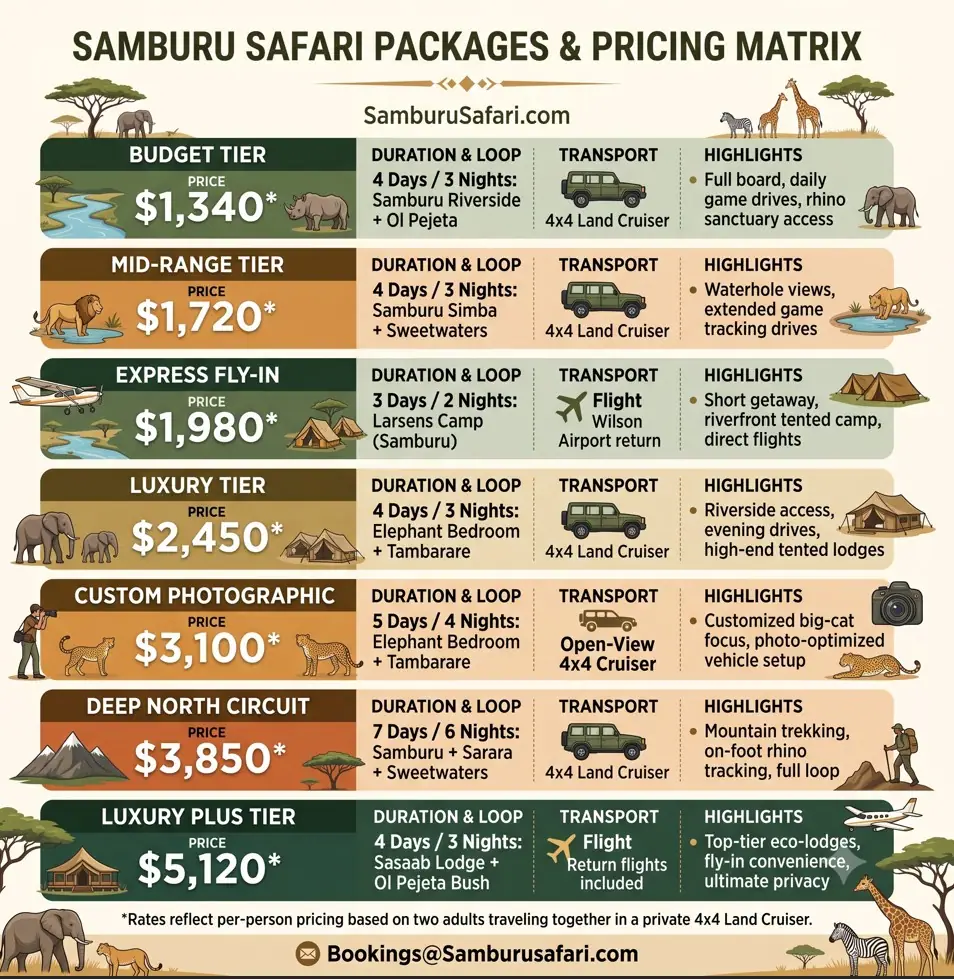
Package | Trip & Lodges | Price Per Person |
Budget Tier | 4D/3N road safari • Samburu Riverside Camp + Comfort Gardens Ol Pejeta • Full board, private 4×4, daily game drives | $1,340 — 👉 Book Now |
Mid-Range Tier | 4D/3N road trip • Samburu Simba Lodge + Sweetwaters Tented Camp • Waterhole views, extended drives | $1,720 — 👉 Book Now |
Express Fly-In Mini | 3D/2N getaway • Larsens Camp (Samburu only) • Wilson Airport flights included | $1,980 — 👉 Book Now |
Luxury Tier | 4D/3N luxury tented stay • Elephant Bedroom Camp + Sanctuary Tambarare • Riverside access, evening drives | $2,450 — 👉 Book Now |
Custom Photographic Tour | 5D/4N tailored route • Elephant Bedroom Camp + Sanctuary Tambarare • Open-view cruiser, big-cat focus | $3,100 — 👉 Book Now |
The Deep North Circuit | 7D/6N complete loop • Samburu Simba + Sarara Camp + Sweetwaters • Mountain trekking, rhino tracking | $3,850 — 👉 Book Now |
Luxury Plus Tier | 4D/3N fly-in package • Sasaab Lodge + Ol Pejeta Bush Camp • Return flights, total privacy | $5,120 — 👉 Book Now |
The dry heat hits your face the second your truck drops down from the green slopes of Mount Kenya into the northern plains. The air down here has its own smell. It is a mix of baked red dirt, wild sage, and the sharp dust of dry acacia pods. Forget the endless, flat grasslands you see in southern Kenya. This terrain is rough, broken up by old volcanic hills, and ruled by the massive stone walls of Mount Ololokwe.
When you set up a trip through Samburusafari.com, you are using real, everyday experience on these dirt tracks. Our senior consultant Angie Muthoni spends her days talking to local bush pilots and property managers to make sure your arrivals actually go as planned. In the bush, independent silver-level guides like Gerard Murero are out on the sand tracks daily, spotting wildlife signs that regular drivers blink and miss.
But look, even experienced crews mess up out here. Gerard learned that the hard way. On his first real drive along the river loops during a dry spell, he ignored what the local cattle herders told him about the shifting sand and drove a heavy cruiser straight into a soft, dry riverbed. His crew spent three hours digging the tires out with basic hand shovels in 95-degree heat while a bunch of baboons barked at them from the palm trees. He tells his clients the same thing every morning now: the bush does not care about your schedule. You read the ground right, or it stops you cold.
When booking your Samburu safari, the type of vehicle you choose shapes your entire experience. Budget operators frequently offer tours in standard two-wheel-drive safari minibuses or vans. While these vans are perfectly fine for the smooth tarmac highway leading up from Nairobi, they quickly face serious challenges once you pass through Archer’s Gate.
The tracks throughout this region consist of deep, soft river sand, sharp volcanic stones, and steep lugga crossings. A standard safari van lacks the ground clearance and the heavy-duty four-wheel-drive low-range gears needed to pull through these traps. Our team uses modified 4×4 Safari Land Cruisers. The superior suspension handles the rough corrugated roads easily, and the higher seating position gives you a much clearer view over the thick thorn bushes when tracking animals. A solid 4×4 vehicle saves you from getting stuck in remote areas where recovery trucks take hours to reach you.
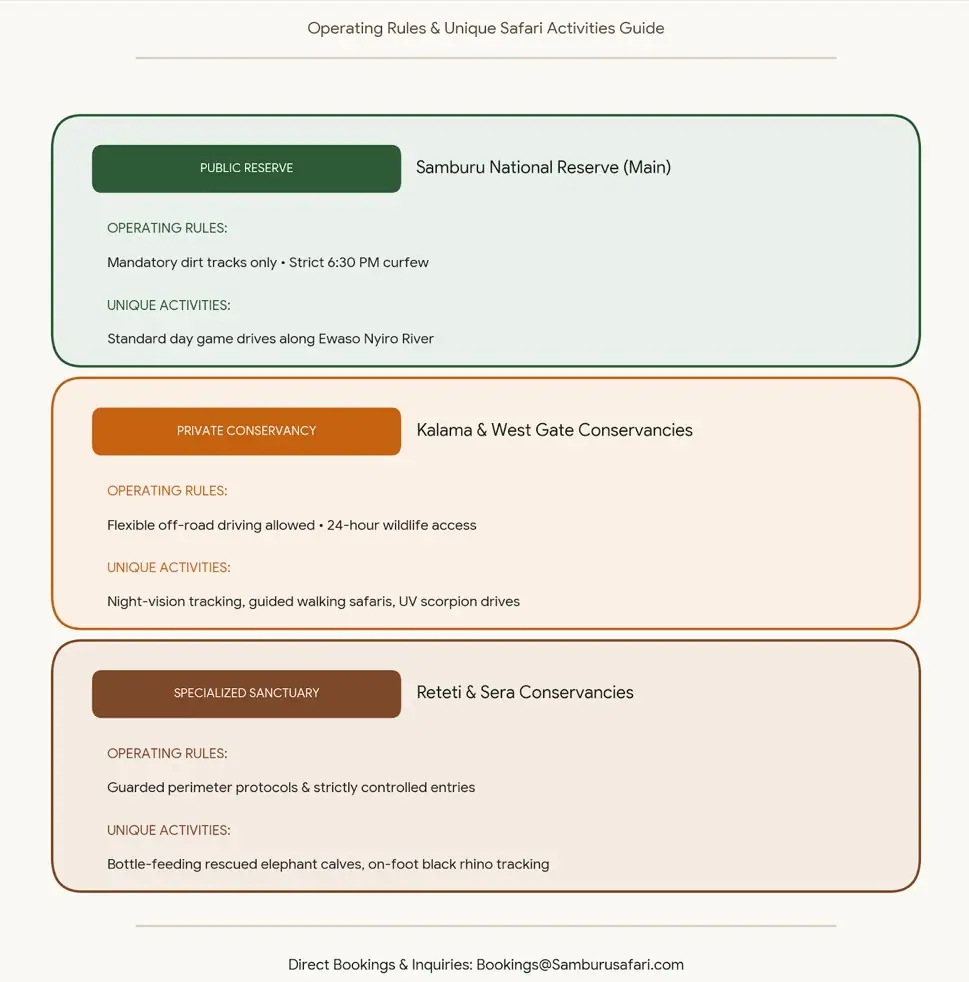
Inside the main Samburu National Reserve borders, you must strictly stick to marked dirt roads, and all vehicles must be back in camp by 6:30 PM. If you want the freedom of off-road tracking for big cats, guided walking safaris, or using specialized night-vision spotters after dark, you should spend at least two nights inside the bordering Kalama, West Gate, or Namunyak Conservancies.
The following table summarizes the differences between public reserves and private conservancies.
Zone Type | Operating Rules | Unique Activities |
Public Reserve (Samburu Main) | Mandatory dirt tracks only; 6:30 PM gate curfew. | Standard day game drives along Ewaso Nyiro River. |
Private Conservancy (Kalama / West Gate) | Flexible off-road driving allowed. | Night-vision tracking, walking safaris, UV scorpion drives. |
Specialized Sanctuaries (Reteti / Sera) | Guarded perimeter protocols. | Bottle-feeding rescued elephants, on-foot black rhino tracking. |
To get the most out of your trip, you have to look at the whole map. Samburu National Reserve is just one piece of a giant, connected wilderness. It sits right next to Buffalo Springs National Reserve, which is just across the water on the south side. Shaba National Reserve sits just to the east. Animals do not care about park borders; they cross back and forth constantly. On a typical morning drive, you will likely cross the concrete low-water tracks between Samburu and Buffalo Springs multiple times.
You must be careful with those concrete low-water tracks, though. They look simple, but they act as major high-water traps. If a sudden mountain storm hits the Aberdares or Mount Kenya hills miles upcountry, a wall of water rushes down the channel. A dry crossing can turn into a roaring, impassable muddy barrier in under forty minutes, splitting your morning tracking route in half.
The Ewaso Nyiro River keeps this whole dry country alive. Without this muddy brown water line, the wildlife could not survive the midday sun. Dense groves of Doum Palms grow along the banks, giving elephants and big cats a cool place to hide when the heat gets heavy.
When you are out on the river tracks, you learn to use specific land markers. Passing the old Isiolo Bridge means you are heading into the thicker, quieter patches of the forest. If you pull your truck up to the high banks at Crocodile Point, you can look straight down at massive Nile crocodiles sleeping on the open sandbars.
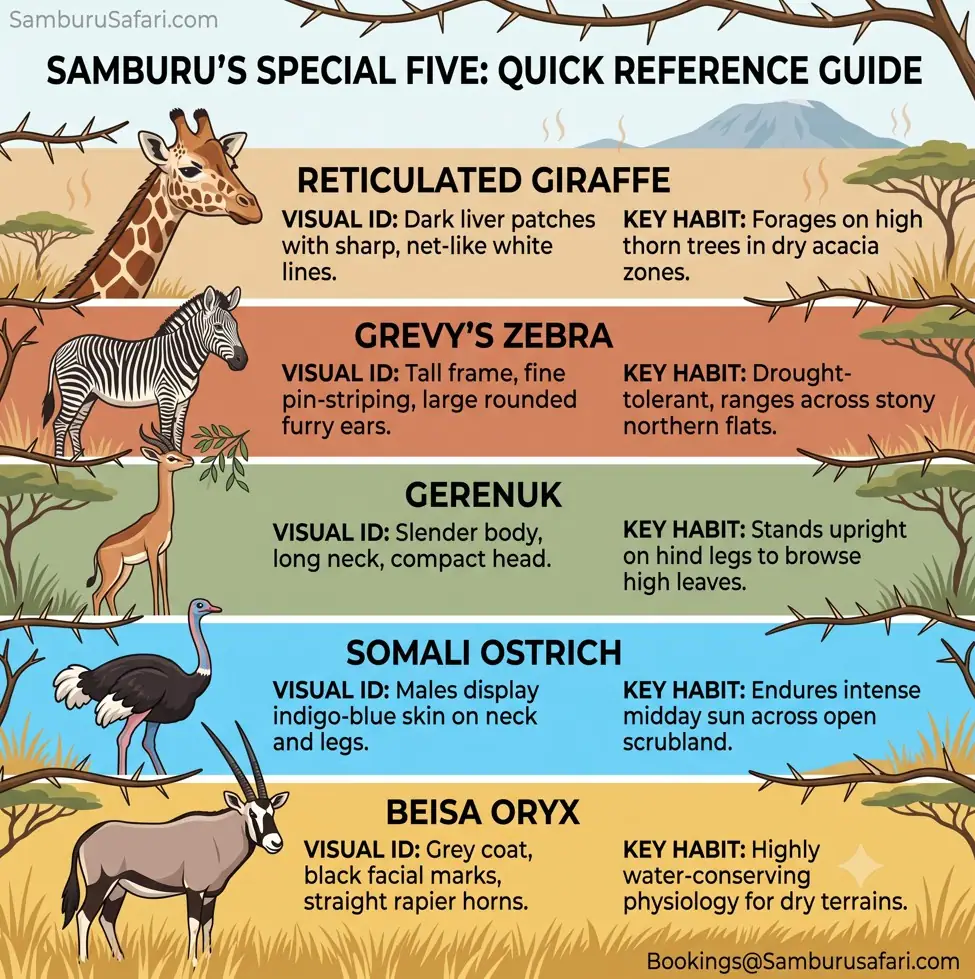
Tracking the Samburu Special Five requires knowing exactly what visual traits and unique behaviors to look for in the arid northern brush. Unlike the southern parks, these rare desert-adapted species have evolved specific habits to thrive along the dry riverbeds and plains. Use this visual cheat sheet to quickly identify each species during your morning and evening game drives.
Species | Visual ID | Key Habit / Behavior |
Reticulated Giraffe | Dark liver patches with sharp, net-like white lines. | Forages on high thorn trees in dry acacia zones. |
Grevy’s Zebra | Tall frame, fine pin-striping, large rounded furry ears. | Drought-tolerant, ranges across stony northern flats. |
Gerenuk | Slender body, long neck, compact head. | Stands upright on hind legs to browse high leaves. |
Somali Ostrich | Males display indigo-blue skin on neck and legs. | Endures intense midday sun across open scrubland. |
Beisa Oryx | Grey coat, black facial marks, straight rapier horns. | Highly water-conserving physiology for dry terrains. |
Southern parks talk all about the classic Big Five. Up in Samburu National reserve, the real prize is finding the Samburu Special Five. These are five specific animals that have changed how they live to survive in dry, hot country. You can read our Samburu Special Five lifestyle guide to learn their tracking habits, but here is what you are looking for:
The connection between these predators and prey runs deep in local history. If you speak with the veteran rangers at the tracking stations, they will often tell you the story of Kamunyak, the famous wild lioness who lived in this reserve. In the early 2000s, she made international news by adopting, protecting, and trying to raise at least six helpless baby Beisa oryx calves, defending them from other prides. That story became local legend, and it shows just how unpredictable wildlife encounters can be up here.
Our drivers always lower their tire pressure a bit when hitting the riverfront tracks. The sand loops get incredibly deep and loose. This river zone is the best spot to watch big elephant families. When the mud dries up, you can watch something odd: these heavy elephants drop down directly onto their knees to scramble up the slick clay riverbanks. The older, larger adults will use their massive foreheads and trunks to physically shove smaller, struggling calves up the slippery muddy slopes from behind.
While exploring the tree lines, keep your eyes open for the local vervet monkeys. The dominant males display glowing, bright neon-blue skin markings on their genitalia. During active breeding weeks, these markings shift into an incredibly sharp, radioactive shade of blue that you can spot from yards away through binoculars.
To see how these herds are tracked and managed, our trips often stop by the Save the Elephants research station in Samburu. The field team there works directly with the global Save the Elephants conservation network to keep these animals safe.
A good trip up north should include time with the people who have lived alongside these wild animals for hundreds of years. The Samburu are pastoral herders. They are related to the Maasai, but they have their own specific language terms, distinct bead patterns, and clan rules. Their whole world still moves around their cows and goats, following the rain to find green grass.
When you visit an authentic local manyatta—a traditional homestead built from mud and thorn branches—it feels completely real. You walk past the brush entry into a dusty courtyard. The women wear heavy, colorful bead collars that show their standing in the community, and the young Moran warriors still look after the cattle with long spears. The air inside their small houses smells heavily of wood smoke and earth.
We stay away from the fake, staged cultural shows that regular tour companies book. We only visit specific villages that run their own community funds. The entry money you pay goes straight into a local account to pay for clean water wells and basic books for the primary school. Sitting down with the elders and listening to the warriors sing their traditional songs gives you a genuine look at the bush.
To give you a practical idea of how a real trip flows, here is how our standard three days on the ground actually run. This short sprint is the right introduction to the northern wilderness tracks for most first-timers.
Bringing the wrong clothes will make your morning drives miserable. The midday sun gets incredibly hot, but the early mornings in an open truck are freezing.
When you leave camp at 6:00 AM, the wind coming off the plains is sharp. You will want a heavy fleece jacket that you can shed later as the day warms up. To check your gear list before you fly out, look at our Samburu safari packing list.
Stick to lightweight, breathable clothes in tan, khaki, or dark green. Do not wear dark blue or black shirts. Those specific colors draw tsetse flies straight to you when you are driving through the thick river bush, and their bites hurt. A wide-brimmed hat, good sunglasses, and a simple dust cover for your camera lenses are items you absolutely must bring.
To see our full list of driving routes, flight schedules, and seasonal options, check out our master directory of Samburu safari packages to start planning your northern trip.
Right now, the entry fee for non-resident adults is $85 USD per person for 24 hours. You have to pay this online beforehand through the eCitizen setup. The gate clerks do not take cash anymore.
The dry, hot air keeps the mosquito numbers down across the open plains. But the slow pools along the Ewaso Nyiro River are a different story. Wear long sleeves after sunset, use a repellent with DEET, and talk to your doctor about taking malaria pills before your plane lands in Kenya.
You will see plenty of lions, leopards, elephants, and buffaloes. But there are no rhinos inside the main reserve because of past poaching issues. Our trips solve this easily by combining your northern drives with a stay at Ol Pejeta or taking you to the guarded rhino sanctuary over at Sera Conservancy.
Our guide made every sighting magical—Samburu’s landscapes and wildlife exceeded all our expectations.

John